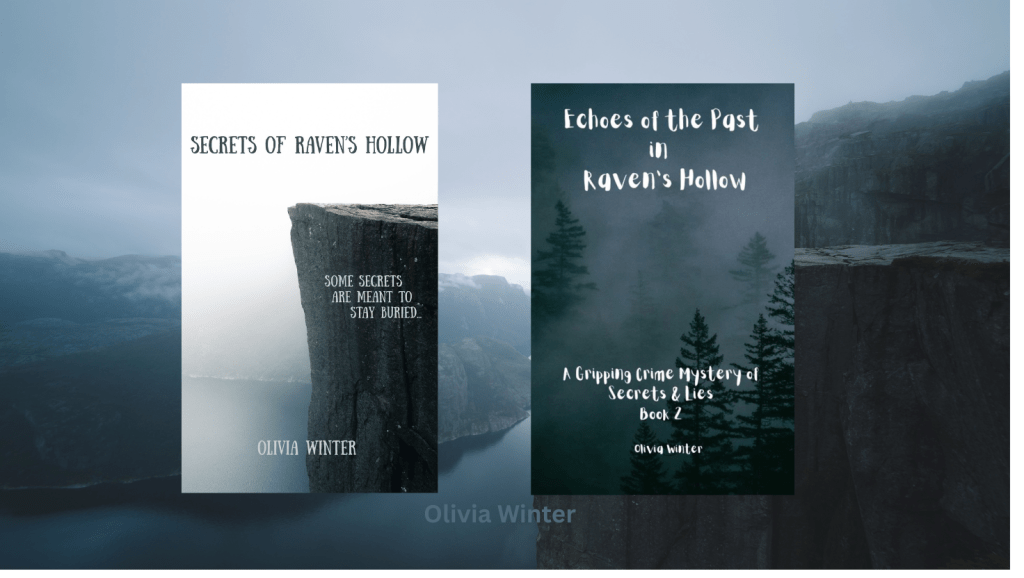
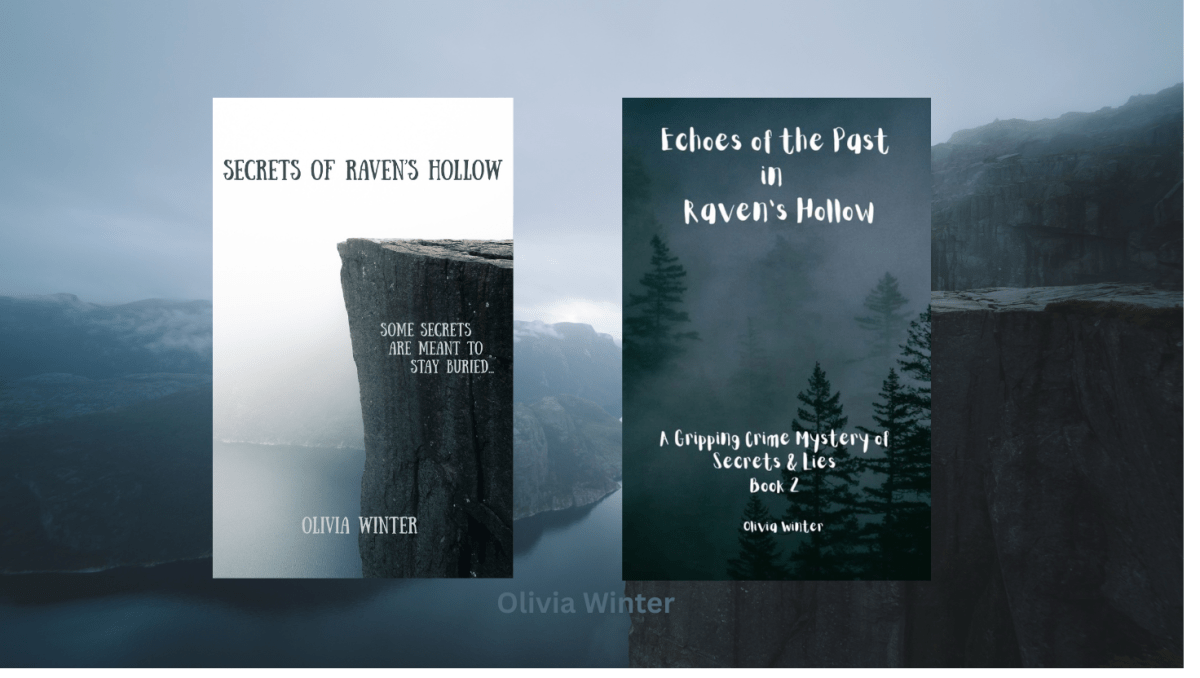
The town of Raven’s Hollow hides its share of secrets – and Claire is about to uncover one that could change everything. In my upcoming novel, Shadows of Raven’s Hollow, I invite you into a world of suspense, mystery, and unexpected twists. With the release just around the corner, hopefully within the month, I couldn’t wait to share a sneak peak with you. So here it is- Chapter One, where Claire’s story begins. I hope you enjoy it.
Chapter One: The Return
The fog hung low over the cliffs of Raven’s Hollow, a thick, suffocating veil that blotted out the horizon. Claire Donovan watched it roll across the town’s narrow streets, wrapping itself around the crooked lampposts and the weathered storefronts that lined Main Street. It was a town out of time, where little seemed to change. Yet, for Claire, everything had.
Raven’s Hollow is a small, fog-shrouded coastal town perched on dramatic cliffs overlooking the tumultuous ocean. Its narrow, winding streets are lined with old Victorian houses, their paint weathered and their windows often dark, giving the town a slightly eerie, forgotten quality. The town’s architecture hints at a once-thriving community, with grand, now-faded buildings that speak of prosperity long gone. Raven’s Hollow is surrounded by dense, twisted trees that seem to creep toward the town, especially near the cliffs, where the branches reach out like skeletal fingers in the mist. The coastline itself is rugged, with waves crashing violently against the rocks below, sending up sprays of saltwater that hang in the air, mingling with the ever-present fog.
The people of Raven’s Hollow are a close-knit and somewhat insular community, their lives deeply tied to the rhythms of the sea and the secrets of the land. The town’s few shops and diners, though modest and unassuming, serve as gathering spots where the locals exchange gossip and keep a watchful eye on outsiders. There’s a sense of mystery that lingers in the air, a feeling that the town holds more stories and shadows than it cares to reveal. Raven’s Hollow seems to guard its secrets closely, its quiet streets and hidden corners echoing with whispers of the past, making it a place where every shadow feels like it has a story to tell.
She hadn’t set foot in Raven’s Hollow in over a decade. She had vowed never to return, not after what happened. But life had a way of pulling you back to the places you’d tried to escape. In Claire’s case, it was the call she’d received three days ago, summoning her back with a story too compelling to ignore.
“Oliver Brooks, dead,” the voice on the other end had said. “Fell from the cliffs.”
For the last decade, Claire had forged a life far from the ghosts of her past. She had pursued her dream of becoming an investigative journalist, navigating through the tumultuous waters of crime, corruption, and the unyielding quest for truth. After leaving Raven’s Hollow, she enrolled in a prestigious journalism program, determined to channel her pain and anger into something constructive. The classes challenged her, but it was the hands-on experiences—internships at local newspapers, then larger metropolitan outlets—that truly shaped her into the journalist she was today.
Her first job was at a small but dynamic newspaper in a bustling city where crime and corruption thrived. Claire uncovered stories about systemic injustices, reporting on everything from housing scams to police misconduct. Each article she wrote earned her recognition and a reputation as a tenacious reporter. But with every revelation came a reminder of why she had left home in the first place. She buried herself in work, hoping that the deeper she dug into other people’s stories, the less time she’d have to think about her own unresolved past.
Yet, no matter how far she traveled or how many stories she chased, the shadow of Zoe’s disappearance lingered in the back of her mind, a constant reminder of her family’s fractured life. She often felt the weight of guilt pressing down on her shoulders, wondering if she could have done more to help her sister if she had stayed. As the years passed, her articles gained traction, leading to opportunities at larger publications, including a stint with a national magazine. But the bigger the stories got, the more she felt the dissonance between her professional life and her personal one.
Claire’s breaking point came during a high-profile investigation into a corrupt real estate mogul—a case that mirrored the ambitions of Oliver Brooks, the man who had recently been found dead at the cliffs. The parallels were chilling. Claire had followed the case closely, uncovering layers of deceit and uncovering the truth about how greed often led to devastating consequences. As she peeled back the layers, she realized that the investigation had consumed her entirely, leaving little room for her own healing.
She worked late nights and early mornings, fueled by coffee and determination, but the toll on her mental health began to show. It was during a late-night brainstorming session, exhausted and staring blankly at her computer screen, that Claire made the decision to take a break. She packed her bags, knowing she needed to return to Raven’s Hollow, to face the past she had long tried to escape.
Driving back through town, she felt a mix of anxiety and nostalgia. The familiar streets evoked memories of laughter, warmth, and the tragic events that had shattered her family. But the town had also changed—new businesses had opened, and familiar faces were replaced by newcomers who had no idea of the heartbreak that lingered beneath the surface.
As she drove, her mind drifted back to the stories that had shaped her journey. She had investigated drug trafficking rings, corruption in local governments, and even human trafficking networks, each time feeling a little more like she was getting closer to uncovering a truth that resonated with her own struggles. Her dedication to justice had become both a lifeline and a burden, consuming her thoughts and leaving little room for anything else.
Now, with the recent revelations about the Syndicate’s involvement in Raven’s Hollow, Claire felt a sense of purpose rekindle within her. This was more than just a story; it was an opportunity to confront the shadows of her past and seek justice for Emily—and for the other victims lost in the wake of corruption.
Claire had barely known Oliver Brooks, but his name carried weight in Raven’s Hollow. A somewhat recent transplant to the town, he was a wealthy real estate developer with grand visions for transforming the sleepy coastal village into a tourist haven
He had arrived in Raven’s Hollow like a storm, sweeping into the small coastal town with all the force of his ambition and charisma. A wealthy real estate developer from the city, he had a vision to transform the sleepy town into a lucrative destination, filled with luxury condos and upscale amenities. To the residents, his move seemed sudden and out of place—why would a man of his status choose their quiet, fog-draped village? He claimed he was looking for a fresh start, a place where he could leave behind the fast-paced chaos of the city. But his true intentions were tied to the untapped potential he saw in Raven’s Hollow’s dramatic cliffs and prime coastal location. He had purchased a sprawling estate on the outskirts, close to the water, where the fog rolled in thick at dusk. Oliver’s arrival stirred both excitement and resentment among the locals; while some saw opportunities for growth, others feared he would destroy the town’s rustic charm. Despite his efforts to ingratiate himself, whispers about his ruthless business tactics followed him, and it wasn’t long before Oliver found himself both admired and despised in equal measure. Most of the town hated him for it, but now, with him gone, the whispers were louder than ever. His death hadn’t been ruled an accident yet, but Claire had a gut feeling it wouldn’t be long before the word “murder” started circulating.
With a deep breath, Claire made her decision. She would use her skills as an investigative journalist to dig deeper into the mysterious circumstances surrounding Oliver’s death and the dark remnants of the Syndicate. Raven’s Hollow was her home, and it was time to reclaim it—not just for herself, but for all those who had suffered in silence.
She continued to drive, determined and resolute, ready to step into the fray and unearth the truths that had long been buried. As she arrived at the Inn, the fog rolled back, revealing the vibrant colors of the town coming to life once more. This time, she was ready to face whatever lay ahead, armed with her pen and a fierce determination to uncover the truth.
As Claire stepped out of her car, the salty sea air hit her, a mix of nostalgia and dread rising in her throat. The waves crashed against the cliffs in the distance, a familiar, rhythmic sound that had once lulled her to sleep as a child. She used to love that sound. Now it felt more like a warning. She walked up the narrow pathway to the small bed-and-breakfast where she’d be staying—a faded Victorian house with peeling paint and ivy creeping up its sides. It was a place she knew all too well, a place she had once called home as a teenager before everything fell apart. The sign outside, “Hargrove’s Inn,” was slightly tilted, the paint chipped and weathered. The owner, Mrs. Hargrove herself appeared in the doorway, her once bright eyes now clouded with age but still sharp enough to catch the smallest of details. Her lips parted into a slow, weary smile that didn’t quite meet her eyes when she greeted Claire.
“Claire Donovan, is it really you?” Mrs. Hargrove’s voice was warm, but her eyes were cautious, as though seeing a ghost. “It’s been too long.”
“Too long,” Claire echoed, forcing a smile that felt as fragile as the memories. She wanted to tell Mrs. Hargrove everything, to explain why she had left, why she had never come back—not even to visit her father—but the words stayed lodged in her throat.
“I’m just here for a few days. Business.”
“Business, huh?” Mrs. Hargrove handed her the key to her room, her curiosity palpable. “I heard about Oliver Brooks. Tragic, really. Not that anyone around here will shed too many tears. He ruffled a lot of feathers, that one. But still… falling off those cliffs is a hell of a way to go.”
Claire nodded, the heaviness in her chest growing. “Yeah. A hell of a way to go.” She took the key and went up the stairs to her room thinking about Mrs. Hargrove. She has been a fixture in Raven’s Hollow for as long as anyone can remember, running her charming bed-and-breakfast on the outskirts of town. The old Victorian house, with its wraparound porch and ivy-covered walls, has welcomed countless visitors over the years. Known for her warmth, discretion, and the best homemade scones in town, Mrs. Hargrove offers more than just a place to stay; she provides a sense of home and comfort that is rare to find. Claire first stayed at Mrs. Hargrove’s B&B when she was a teenager, during a turbulent period in her life. After her family fell apart following her sister’s sudden disappearance, Claire found herself needing a place that felt safe yet removed from the haunting memories of her own home. Mrs. Hargrove offered her a quiet refuge during that time, treating Claire with the kind of care and understanding she desperately needed. The bond they formed then has lasted through the years, and even now, Claire feels a deep sense of trust and loyalty toward Mrs. Hargrove. The bed-and-breakfast remains a symbol of stability for Claire—a place tied to both painful memories and a glimmer of solace.
As she entered the small room that had once been her refuge, she felt the years fall away. The creaky wooden floor, the old armchair tucked in the corner, the faded floral wallpaper – all untouched by time, just as she remembered. She set her bag down on the bed and moved to the window, watching the fog roll in, thickening, almost alive as it coiled around the town, swallowing it whole.
A knock at the door broke her reverie. She opened it to find Tom Hale, the town’s local detective, standing there, looking as gruff as ever in his worn-out police uniform and his face etched with lines of fatigue and wariness. He looked like he had seen too much of life’s ugly side – too many cases that never quite added up. He had heard she was back in town and knew her reputation as a skilled investigative journalist, but his visit wasn’t just a casual drop-in. Tom was deeply familiar with Claire’s past—the disappearance of her sister Emily and the painful circumstances that had led Claire to leave the town all those years ago. Now, with Oliver Brooks’ suspicious death causing ripples through the community, Tom had a hunch that this case might be bigger than it seemed. He believed Claire’s investigative skills and personal connection to the town could help unravel the truth, and, despite knowing the emotional baggage she carried, he needed her insight. No matter how far Claire traveled or how deeply she buried herself in her work, she could never escape the shadow of her sister’s mysterious disappearance—a mystery that had driven her from Raven’s Hollow in the first place. The grief and unanswered questions surrounding Emily’s vanishing had haunted Claire for years, leaving her unable to face the town where everything had fallen apart.
When Tom shows up at the inn, he comes with a sense of urgency, but also with a quiet understanding. He knows how hard it must be for Claire to return after so long, and part of him wonders if her instincts about this new case might also tie back to her sister’s unsolved disappearance. Tom sees Claire’s return as an opportunity—not just to solve Brooks’ death, but perhaps to finally bring some closure to the lingering mysteries that had haunted them both for years.
“Claire,” he said, his voice a mix of surprise and something she couldn’t quite place—concern, maybe. “Heard you were back in town. Didn’t expect to see you, though. Not after all this time.”
“Yeah, well, life is full of surprises,” she replied, leaning against the doorframe. “I hear Oliver Brooks took a dive off the cliffs.”
Tom sighed, rubbing a hand over his face. “That’s the story going around, but something about it doesn’t sit right. The man didn’t have a reckless bone in his body. He was too careful, too controlled.”
“Are you saying it wasn’t an accident?” Claire’s curiosity piqued, and the journalist in her took over.
“I’m not saying anything for sure yet, but…” He lowered his voice, leaning in slightly. “a man like Brooks doesn’t make friends in a place like this. He makes enemies, Claire. And not just the kind that file lawsuits. These enemies don’t play by the rules.”
Claire’s pulse quickened, the thrill of the mystery reawakening something in her. “Who are we talking about?”
Tom hesitated, then shook his head. “Nothing I can share right now. Official investigation and all. But if you’re planning on sticking around for a while… be careful. This town isn’t what it used to be, it’s got more shadows than it used to, and not all of them stay in the dark.”
Claire studied Tom for a moment, her mind racing as she tried to piece together the implications of what he was saying. “You’re telling me there’s more to this town than meets the eye,” she said, her voice steady, but there was a flicker of something in her eyes—determination, maybe even excitement. The journalist in her was already digging, pulling at the threads of the mystery he was hinting at.
Tom nodded slightly but remained tight-lipped. Claire leaned back, crossing her arms. “I’ve been gone a long time, but I’m no stranger to shadows,” she said, her gaze sharp. “If there’s something here, I’ll find it. You know I will.”
Tom sighed, knowing her too well to think she’d let this go. “Just don’t dig too deep, Claire. Some things… some people… don’t like the light. And you’re not the only one they’ll come after if they feel threatened.”
Claire gave him a small, wry smile, the fire in her eyes unmistakable. “I’ve faced bigger monsters than this town has to offer, Tom. If someone’s trying to hide something, they’ve just made themselves a new problem.”
With a nod, Tom tipped his hat and left her standing there, the door half open and her mind already racing with questions.
As the evening descended, Claire found herself drawn to the cliffs where Brooks had died. She drove up the winding road, past the old lighthouse that had stood watch over the town for generations, and parked near the edge. The fog was lighter here, but the drop into the black waters below was no less deadly. The jagged rocks that jutted out from the sea could tear a person apart. She stood at the edge of the cliffs and peered over, imagining Oliver Brooks tumbling down, arms flailing, the wind whipping his face as he fell. She imagined the terror he must have felt, the hopeless scramble to find something to hold onto. But something didn’t add up. People didn’t just walk off cliffs—not without a reason.
Her phone buzzed in her pocket, pulling her from her thoughts. She glanced down at her screen and saw a text from an unknown number:
Be careful where you look, Claire. Some things are better left buried
Her heart skipped a beat as she stared at the message, the hairs on the back of her neck standing on end.
She glanced around, but there was no one else in sight just the cliffs, the dark, swirling ocean below, and the silent town hidden beneath the veil of fog. Claire knew one thing for certain: Oliver Brooks hadn’t just fallen. And whoever had sent that message wasn’t going to let her uncover the truth without a fight. They were watching her every move.
With the fog thickening and the town’s secrets closing in, Claire’s return to Raven’s Hollow was about to get a lot more dangerous than she had ever imagined.
End of Chapter
Does this chapter leave you wanting more? I’d love to hear your thoughts in the comment section. Stay tuned for updates. There is so much more to come from Raven’s Hollow!







 Postpartum Wellness